Japanese Hon Dashi Bonito Fish Soup Stock - 2.29 oz x 2 bottles
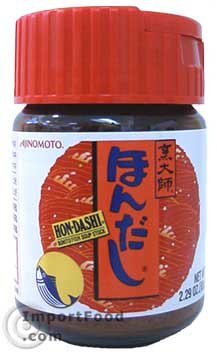 This bonitofish soup stock is used for soup base for miso soup, hot pot, and soup noodles. Dashi is the most important flavor of Japanese food and it's used in many different dishes, and you can use this instant version or make it from scratch with katsuobushi. To make dashi using this product, simply add to boiling water and stir (1 tsp Hon Dashi to 1 cup water). As a variation, use the liquid in which dried shiitake mushrooms have been soaked. Sometimes translated as broth, dashi is actually much more. Its not only an essential ingredient for literally thousands of Japanese dishes, its also a deliciously creative way to add irresistible flavor to foods while reducing sugar and salt content. Have you ever had the feeling that some flavor is missing, but you dont know what it is, or what to add? Try adding a little Hondashi. We offer the best quality Ajinomoto brand. Picture is 2.29 oz jar but now we offer a box containing three sachets, 1.76 oz each sachet.
Customer Review: The Missing Ingredient
This really is the missing ingredient to all of your attempts at making traditional japanese food! It may seem odd that fish is used as a "spice", but it really almost is just that. I tried making steamed japanese vegetable with mirin & soy sauce figuring that Mirin was the missing ingredient. But it wasn't until I read on one of the packages that hon dashi is required, that I discovered the true missing ingredient! I bought fresh miso to make miso soup, and it too didn't taste right. Added a spoon of hon dashi and suddenly I had real Miso Soup! (actually i found out later you can buy fresh miso for miso soup with the dashi already added) Hon dashi is great for soup stock for udon or soba too. Buy some and add a little to whatever doesn't taste quite japanese enough.
If you are baking the eggplant whole, lightly puncture the skin in several places with a paring knife to prevent pressure from building up inside the eggplant, which can result in eggplant ending up all over the inside of your oven. Unlike many vegetables, eggplant doesn't really suffer from extended cooking periods - an undercooked eggplant will have a more chewy texture, whereas eggplant that has been overcooked simply becomes softer.
- Reducing swelling
- Clearing of stagnant blood
- Reducing hemorrhages
- Comforting bleeding hemorrhoids
- Treating dysentery
- Reducing the risk of stroke and heart disease
- Reducing steroidal hormones which are linked to tumor growth
- Prevention of cell oxidation, which can lead to cancer
- aubergine
- eggplant
- brinjal
- melanzana
- garden egg
- egg apple
- patlican
Listada de Gandia
o Shape: long oval shape, green thorny calyxes that curl
o Appearance: stunning white and purple stripes
o Flavor: mild white flesh; slightly bitter skin
o Other: meaty, creamy texture, holds shape when cooked
Health Benefits
Botanically it is a fruit, but most often it is referred to as a vegetable, and for those who enjoy it, there is a long list of medicinal benefits. High in bioflavonoids and the antioxidant monoterpene, the eggplant is effective at assisting with a number of health items, including:
White Egg
o Shape: shaped like chicken or duck egg
o Appearance: white
o Flavor: sweet, mild, somewhat watery-tasting
o Other: firm flesh; tough skin; holds shape when cooked
Lao Green Stripe
o Shape: golf ball shape, pointy calyx "hat"
o Appearance: striped
o Flavor assertive flavor
o Other: also called "Thai Green Stripe", seedy texture
The flesh behaves much like a sponge and will soak up the juices and oils it is cooked in. In some cases this is a good thing, such as when you are marinating the eggplant. However, in other cases this isn't so desirable, such as when frying. In applications where absorption is not desired, coating sliced eggplant in some sort of breading is a common way to avoid soaking up too much oil during cooking. The real key to success using this method is to let the breaded eggplant sit in the refrigerator for half an hour before frying. Other methods for reducing the absorbency of eggplant include:
Rosita
o Shape: long, oval shape
o Appearance: bright lavender color, white flesh
o Flavor: mild, sweet flavor
o Other: smooth, tender flesh and skin; Puerto Rican
Wash the eggplant just before peeling or using it. Using a stainless steel knife to avoid discoloration, remove the cap and stem. Once cut, eggplant flesh will naturally begin to darken with exposure to air, so place cut slices or pieces in a salt or acidulated water bath to keep the flesh white. Be sure not to use an aluminium pot when cooking eggplant because it too will discolor the eggplant and provide it with an off-flavor.
Eggplant should not be eaten raw due to its higher solanine content as well as its extremely fibrous meat, both of which break down during cooking. Eggplant may be cooked with or without its skin, but some may find the skin bitter. Because large eggplants and most of the white varieties have a thick, tough skin, and because bitterness is concentrated just under the skin, they should be peeled with a vegetable peeler prior to cooking. While not really necessary, some cooks will also salt the cut eggplant and let it sit in a colander for a short period to leach out water and bitterness before cooking.
As a rule of thumb, 1 average-sized eggplant will serve 3 people, and one pound of eggplant is equal to roughly 3 to 4 cups of chopped eggplant.
Thai Long Green
o Shape: long, slender shape
o Appearance: lime green skin, white flesh
o Flavor: sweet and nutty, reminiscent of green beans
o Other: Thai; velvety flesh and skin; seedless; short shelf life
The eggplant (Solanum melongena) belongs to the nightshade family of plants. This diverse family of plant includes members like the poisonous Jimson weed and Deadly Nightshade, as well as more familiar and non-poisonous plants like tomatoes, potatoes, and peppers. The members of this family of plants all contain a toxic alkaloid called solanine, which can cause diarrhea, headache, vomiting, and even heart failure in those who are overly sensitive to it. Fortunately for most us, this amounts to a very small percentage of people.
In it's history, because of its relation to these potently toxic plants, Europeans called the eggplant the "Mad Apple", due to their belief that eating one would drive you insane. Even after it proved itself as a safe and useful food product, the poor eggplant still had a difficult time of removing this negative moniker. Even though the eggplant was among the numerous plants introduced to America by the Spaniards several hundred years ago, it wasn't until sometime during the mid 1900's that eggplants were commonly recognized as an item that could be used for something other than ornamental purposes.
Globe
o Shape: oval or pear shaped
o Appearance: glossy deep-purple to black skin, cream to green flesh
o Flavor: mild with a slight bitterness and a soft texture
Rosa Bianca
o Shape: round
o Appearance: white skin with lavender streaks, white flesh
o Flavor: sweet flavor
o Other: Italian eggplant; creamy yet firm texture, retains its shape when cooked
Selecting Eggplants
The Mad Apple a.k.a. Eggplant
Storage
- Par-boiling slices for 1 to 2 minutes. Be sure to thoroughly drain and gently pat the slices dry with paper towels before further cooking.
- Microwaving will also help to remove excess water. Microwave slices on high for 4 to 6 minutes, remove, cover and let stand for a minute or two. Use paper towels and press lightly to soak up the water.
Look for a symmetrical eggplant with smooth, uniformly colored skin. Tan patches, scars, or bruises indicate decay. Also avoid eggplants with wrinkled or flabby-looking skin. Oversized purple eggplants, usually over 6 inches in diameter, may be tough and bitter. When you press gently on an eggplant, the finger mark will disappear quickly if the eggplant is fresh. Eggplant should feel heavy; one that feels light for its size may not have a good flavor. The stem and cap should be bright green and healthy, not browned and wilted.
In North America, the Globe variety reigns supreme. But around the world where eggplant is far more popular, such as the Orient, eggplants of numerous varieties, shapes, flavors and colors can be found. Some of the more common varieties available at your grocer and Asian and Middle Eastern food stores are:
Common Varieties
Both cold and warm temperatures can damage eggplant. It is best to store eggplant uncut and unwashed in a plastic bag in the cooler section of the refrigerator. Do not force the eggplant into the crisper if it is too big, as this will bruise the vegetable. Eggplant may be blanched or steamed then frozen for up to 6 months.
Pintong Long
o Shape: long and slender
o Appearance: deep purple to lavender skin, green to purple-black calyxes, white flesh
o Flavor: sweet with a nutty flavor
o Other: buttery texture; Taiwanese
Available year round with its peak season in August and September, the eggplant is known worldwide, and by a wide variety of names:
posted by mercy--60550 at 5:56 PM
0 comments