The Food of Thailand: A Journey for Food Lovers (Food Of Series)
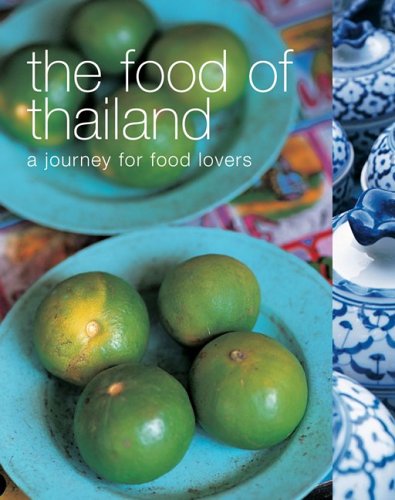
Thailand has an increasingly well-known and well-loved repertoire of dishes, some more familiar than others. This culinary journey guides readers through Bangkok's markets to the seafood freshly cooked on the beaches of the Gulf of Thailand, to the sweet-makers of Phetchaburi province to the rice-growing hill tribes of the northern region.
The Food of Thailand features a myriad of dishes that make up modern Thai cuisine: from traditional green, red, and panaeng curries, eaten by every Thai, to salads like som tam and laap, redolent with herbs and chillies, and coconut-based soups, including the famous tom khaa kai.
To partner the recipes, special pages explore the essence of Thai food and cooking techniques. Subjects include:
- Making fish sauce
- Preparing som tam
- Mixing and pounding curry pastes
- Carving fruit.
About The Food of... series
A culinary journey around the world.
Each book in The Food of... series is a comprehensive introduction to the world's great cuisine. These books feature more than 100 delicious recipes that highlight each country's culinary treasures. With instructive color photographs throughout, each recipe helps readers choose and identify produce, from vegetables and flavorings to street snacks, sweets, and colorful and exotic fruits. Feature sections explore the essence of each culture's food and cooking techniques.
Customer Review: the best of the best
More than a cookbook, "The Food of Thailand" is a cultural revelation and a "journey for food lovers." This book is my prize cookbook, the one I value above the others, and I have a wonderful collection of cookbooks. What makes this one so special is the incredible array of photographs of sections of the country, the people, the foods both in preparation and sold on the streets. Once the reader travels all the pages from front to back, s/he has made a journey through Thailand and its magnificent variety of foods. A large volume at 9 1/2 x 12, this volume, published in Australia, makes a fabulous coffee table book. Every recipe has at least one photo. Every time I open it, I take mental walks through Bangkok, where I spent nine fascinating days a couple of years ago. I stayed at the seminary compound, where I catalogued English-language books. I ate lunch with the students each school day and experienced just a smattering of the variety of foods available on a school campus. The main dish was always some type of stew or soup served with rice, one of the two basics that goes with most meals. The other is noodles. Someone always brought some kind of fruit from home for dessert. My favorite are the rambutans, a deep red fruit about the size of kiwis, only with soft spikes all around. The outer layer is peeled off to reveal an exquisite tasting fruit akin to sweet grapes. Thai food is unlike any other food, perhaps because it is exotic, blending unusual combinations of flavors like chile sauce and peanut butter. The names are playful: Son-in-Law Eggs: deep-fried hard-boiled eggs with a fish/tamarind sauce poured over length-wise sliced halves and crispy chiles and shallots sprinkled on top. Or Gold Purses: wontons filled with minced water chestnuts, spices, shallots, and shrimp, then fried golden. These are Chinese influenced. Or Chicken Wrapped in Pandanus Leaf: a chicken mixture wrapped in the reed-like leaves, deep-fried and drained. The leaves serve as decoration, holders, and flavor makers. Other fabulous recipes: Green Papaya Salad, Stuffed Tofu Soup with Prawns, Prawn and Pomelo Salad, Fish Steamed in Banana Leaf (just go outside and pluck a leaf--most houses have their own banana tree), Deep-Fried Fish with Ginger, Snapper with Green Banana and Mango, Curry with Beef and Potatoes and Peanuts, Thai Fried Noodles with Prawns (my favorite!) Baby Eggplant and Cherry Tomato Stir-Fry Coconut Ice Cream, Coconut Pudding (both to die for) If you can get one cookbook for use and/or sheer beauty and exotic pictures, "The Food of Thailand" is one I highly recommend.
Customer Review: close to home cooking!
This is an awesome cookbook. I love the enticing pictures that accompany the recipes. I'm no chef but I've had a lot of success in many of the recipes in this book. Highly recommended for anyone interested in learning to cook thai food.
Ancient Chinese food was based around rice as far back as 5000 BCE. Interestingly, the evidence from around the Yangtse River watershed points to not only boiled rice but to the fermented product that we know as rice wine. It was probably an accidental discovery, but one that has remained very popular throughout Chinese history.
Ancient Chinese Food may not have been the most varied. This was largely because of China's relative isolation. Only when hardy adventurers traveled along the Silk Road routes did wheat, cattle and sheep arrive in China. More variety was introduced when China expanded southwards, and especially when sea trade brought lots of exotic foodstuffs to Guangzhou (Canton) and beyond. Those developments were for later.
In the north, where it was too cold for rice, the local farmers grew millet and some sorghum. These could also be boiled into porridge, or fermented to produce alcohol.
Chickens were probably adopted from the area that we now know as Thailand. These were almost certainly domesticated before pigs. Even today, Dai people (Dai and Thai being pretty much interchangeable) live in Xishuangbanna, the area bordering the modern SE Asia countries of Laos and Myanmar (Burma).
When looking at ancient Chinese food we shouldn't forget the popular drinks. Boiled water has always been the favourite as it has long been a principle that food and drink should be consumed when at a temperature similar to the bodies so as not to disturb the natural balance. This preference may have lead to the discovery of tea leaves as flavouring.
Certainly the early Chinese seem to have experimented with lots of plants and drying methods to produce a wide range of tasty and healthy beverages. The favourites now are:- Green teas - especially those from Longjing near Hangzhou;
- Fermented teas - Pu'er Tea and Oolong are perhaps the most famous of these; and
- Flower teas - such as Jasmine and Chrysanthemum.
Wild pig species are native to southern China and appear to have been domesticated around 2000 BCE. It's not known at what stage hunting was replaced by domestication and farming of pigs - bones don't tell that story - but this was probably after the introduction of chickens.
One ancient Chinese food item not developed elsewhere is tofu. This fermented bean product was thought to have been made from about 1000 BCE. The soya bean is tasty and supposedly endowed with healthy characteristics. It is meant to be particularly good for diabetics. Soya milk is another product still consumed today.
Food preservation techniques allowed the ancient Chinese to keep seasonal crops year round. Salting of meat and pickling of vegetables have long added to the variety of foods, especially over the winter period. Many people still eat rice porridge with pickled vegetables for breakfast. It's simple to prepare and easily digested.
Ancient Chinese Food
posted by mercy--60550 at 5:45 PM
0 comments

